Monday, 16 February 2015

Scarlet lily beetles and other pests


The February 2015 meeting of the Garden Club of PEI featured Christine Noronha, Entomologist with Agriculture and Agri-Food Canada.  She talked about the most common insect pests we encounter in our gardens.


Scarlet Lily Leaf Beetle appeared on PEI in 2004.  It has since spread across the province.  It is native to Europe and Asia.  It was first seen in North America in Montreal in 1943, and has moved across eastern Canada and as far west as Alberta. It is thought to have spread through the importation of plant bulbs.

These beetles overwinter in the soil as adults.  They emerge in early spring and lay about 450 eggs in batches of about 12 on the underside of leaves.  The larvae feed under the leaves.  They are reddish, but are identifiable as black blobs, because they cover themselves in their own frass (excrement) which makes them unattractive to predators.  Mature larvae drop to the ground, burrow into the ground, and make a cocoon.  One generation per year is produced.

Host plants:  mostly lilies.  asiatics are most susceptible.  They also feed on fritillaria, lily of the valley (convularia), flowering tobacco (nicotiana), hollyhock, hosta, potato, and solomon’s seal (polygonatum).

To manage these pests:
·         hand pick adults and crush or drop them into a container of soapy water.  The soap will prevent them from breathing.
·         spray with diluted neem oil.  Neem degrades quickly in warm weather, and must be reapplied at least every 5 to 7 days.
·         young larvae are more susceptible to insecticides than adults.  Spray the underside of leaves where larvae feed. 
·         floating row cover may be effective.
A parasitic wasp, Tetrastichus setifer, lays its eggs in beetle larvae.  When the eggs hatch, the wasp larvae eat the beetle larvae from the inside.  PEI has a low number of species of naturally-occurring parasitic wasps (4) vs Ontario (12).

According to http://lilybeetletracker.weebly.com/ this wasp was introduced in Ottawa in 2012 and a researcher at Carleton Univerisity wants to introduce the wasp to other areas across Canada.  According to her studies, the wasp attacks only lily leaf beetles, and it survives the winter.  Gardeners are welcome to sign up to introduce pupae and eggs to their gardens.

Image result for aphids on plants
Aphids are soft-bodied, tiny, pear-shaped insects that can be brown, black, green, white, or grey.  They can be identified by short tubes protruding from the base of the body, and a waxy or woolly coating. 

Females produce live babies.  They are like Russian dolls - one inside the other.  Babies are born already pregnant, and the babies inside the babies are also already pregnant!  For that reason, aphids reproduce very quickly.  The babies produced are wingless, but if populations become too large and food becomes scarce, babies are born with wings so that they can fly to a new food source.  During the summer, all babies born are female.  In fall, both males and females are born with wings.  They mate and lay eggs, which overwinter. 

Aphids have mouthparts that pierce the stems of plants to suck out plant juices.  Because they attack multiple plants, they can spread disease.  This is a problem for commercial growers.

Aphids feed in large groups on the undersides of leaves.  Predators include lady beetle larvae and adults and predatory wasps, which lay eggs inside the larvae. Spraying with insecticidal soap is effective, but you can also just spray with plain water to knock them off the plants.

Greenhouse growers use Aphidius colmani - one package per square metre.  A BC company called Bug Factory sells these.  This is not as effective in open areas.

Image result for earwig larvae
Earwigs – males have curved pincers, females have straight pincers.  The females are very good mothers.  They lay eggs in a nest in the ground and feed and protect their young for several weeks until they are ready to leave the nest in early July.  Babies hatch looking like smaller adults – no larvae stage.   

Earwigs are most active at night.  In the late fall, their blood is replaced with a substance that acts as antifreeze, and they are able to withstand the winter.  Adults emerge in spring, lay eggs, tend their young, and then die.

Management: 
·         break up soil and expose eggs on surface for predators. 
·         rolled up newspapers or pieces of garden hose will attract them during the day.  Shake the paper and hose into a bucket of soapy water.

Image result for mites on plants
Mites feed on the undersides of leaves.  Females lay about 300 eggs on the branches or stems of their host plan and overwinter there.  They hatch in early spring and begin feeding.  They grow from egg to adult in just 5 days when it is warm, longer when is cool.  Several generations are produced in one year. 

Management:
·         bring in lady beetles, lacewings, or predatory wasps.  This works best in confined space like a greenhouse
·         spray with insecticidal soap, neem, or a registered insecticide.  To be effective, there must be direct contact with the insect.

Image result for thrips
Thrips have lacy wings that look like feathers.  There are 6 stages to the life cycle:  egg, 2 larval stages, prepupal, pupal, adult.  One generation takes one month to complete.  They are poor fliers, and are carried by the wind.  Thrip damage makes leaves appear brownor mottled silver, and dry rather than wilted.  They feed on the underside of leaves. 

Management:  Biological controls are not successful.  Because they feed on weeds, keep weeds controlled.  They also will attack stressed plants, so keep your plants well watered and healthy. 

Image result for carrot rust fly
damage from carrot rust fly larvae
Carrot rust fly larvae feed on the tissue of carrots.  It is very small, with red eyes, orange head, a shiny back, and clear wings.  They lay eggs in the soil at the base of carrots.  Eggs hatch in 6-10 days.  Larva feed on carrots, celery, parsley, parsnip, dill, caraway, and fennel.
Management:
·         They are poor flyers, so putting up a low barrier can deter them
·         cover with floating row cover
·         avoid bruising carrot leaves – they are attracted to the scent
·         seed carrots later in the season to avoid the larvae’s life cycle
·         harvest carrots before the second week in September to avoid major damage
·         Resistafly is a variety of carrot seed available at Vesseys.com.  It’s leaves have no scent, and does not attract carrot rust fly.

Image result for cutworm
Cutworms overwinter as eggs, larvae, pupae and as adults.  They feed by cutting young seedlings at their base.  They are attracted to weedy areas. 
Management: 
·         cultivate soil to expose cutworms to predators
·         planting late starves them
·         they are nocturnal – hand pick at night
·         put a collar of cardboard or foil around each plant
·         they overwinter in debris – clear away their habitat
·         ground beetles and birds are great predators
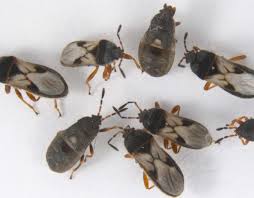
Image result for chinch bugs images
Chinch bugs have sucking mouthparts that feed on grass blades and roots.  Adults are black with white spots and white wings.  The nymph is bright red with white bands across the back.They are attracted to poorly tended lawns and compacted soils with lots of thatch buildup and lack of moisture.
Management:
·         aerate and remove thatch from lawns
·         use slow-release fertilizer and lime
·         keep lawn moist
·         do not cut lawn too short, which stresses the plants
from left:  larva of Japanese beetle, European chafer, and June beetle
June beetles have a 3-year life cycle.  Grubs eat grass roots.  In June, adults lay their eggs in the soil.  They hatch in 2 weeks.
Management:

  • a healthy lawn is the best protection against grubs
  • skunks and crows are dig up the lawn to feed on grubs
  • parasitic nematodes will control them – need the right kind, and the soil must be moist to be effective

Image result for japanese beetle
Japanese beetles have invaded PEI in the last 4 years.  There is a huge population in the Charlottetown, Cornwall, Canoe Cove area. They attack trees such as crab apple, elm, maples, but mostly concentrate on roses.  The beetles are very beautiful, with iridescent bodies, but very destructive.  The larvae are in the ground where they attack roots.  The adults can skeletonize leaves very quickly.  They overwinter as grubs that are smaller than June beetles.
Management: 
·         hand pick and knock into jar of soapy water
·         insecticidal soap must make direct contact with beetle
·         pheramone use:  be cautious, because this attracts more to your area
·         check soil in late summer:  more than 12 grubs per square feet means you need to treat the lawn
Image result for colorado potato beetle
Colorado Potato Beetle attacks potatoes, tomatoes.  The yellow eggs are laid on the underside of leaves.  The young and the adults feed on leaves.  The young shed their skin 4 times as they grow (instars) and overwinter in the ground. 
Management:
·         hand pick and knock into jar of soapy water
·         kill eggs by crushing
·         Bacillus thurengis may work on larvae
Image result for striped cucumber beetle bacterial wilt

Striped Cucumber Beetle overwinters as an adult.  It lays eggs in the soil.  Adults eat leaves, pollen, and flowers of cucumber plants.  The larvae eat the roots and stems.  It can spread bacterial disease, which appears as bacterial wilt.  Infected plants cannot be saved.
Management: use floating row cover to keep them away from plants.
Image result for colorado potato beetleImage result for colorado potato beetle
Image result for sawfly
Sawflies – Rose Slug look like tiny caterpillars.  When you disturb the larvae, they raise their back end, which caterpillars do not do.  Adults lay eggs on leaves, and the larvae eat all spring and summer, skeletonizing the leaves.  Host plants include roses, raspberries, ash, elm, dogwood, willow.  They are hard to remove from the plant because they are on the undersides of leaves.
damage from viburnum leaf beetle


Image result for viburnum leaf beetle

Viburnum leaf beetle is greyish-brown. The yellow and black larvae eat holes in viburnum leaves, leaving only the large veins behind.  To check for an infestation, check stems of plants.  Rows of bumps mean there are eggs buried in the stem.
Management:
·         They are too numerous to hand pick.
·         In fall when leaves have fallen, cut off infected stems
·         Spray insecticide when larvae are young
Image result for colorado potato beetle·         They crawl down the stem to the ground to pupate.  Covering stems with tanglefoot can trap them.

Image result for brown marmorated stink bug
Brown marmorated stink bug, an insect not previously seen on our continent, was accidentally introduced into Pennsylvania. It was first collected in 1998. 

Adults are approximately 17 mm long and are shades of brown on both the upper and lower body surfaces.  They have the typical “shield” shape of other stink bugs, almost as wide as they are long. To distinguish them from other stink bugs, look for lighter bands on the antennae and darker bands on the membranous, overlapping part at the rear of the front pair of wings. They have patches of coppery or bluish-metallic rounded depressions on the head.

The name “stink bug” refers to the scent glands located on the dorsal surface of the abdomen and the underside of the thorax. It releases a bad odour if crushed.

In its native range, it feeds on a wide variety of plants, including apples, peaches, figs, mulberries, citrus fruits and persimmons. This true bug has also been reported on many ornamental plants, weeds, soybeans and beans for human consumption. Feeding on fruits such as apple results in a characteristic distortion referred to as “cat facing,” that causes the fruit to be   unmarketable.

These bugs are a big problem in the US and have been found in the Niagara region of Ontario, where they are a major threat to fruit production.  They were spread by hitching rides on Home Depot trucks moving goods from the US to Ontario, and have been found on trucks on PEI as well.  These bugs even survive going through the washing machine.

If you find this bug on PEI, please catch it in an escape-resistant container and bring it to Christine Noronha at the Agriculture and Agri-Food Canada building on University Avenue in Charlottetown, or call her at 902-394-1350.


Sunday, 18 January 2015

Late Blight

Ken MacDonald, garden club member, checks out information about late blight provided by Rick Peters, plant pathologist.
The January 2015 meeting of the Garden Club of PEI featured guest speaker Rick Peters, plant pathologist at Agriculture and Agri-Food Canada. Rick earned his degree at the university of Guelph, and has worked on PEI since 1994.  He spoke about his research into late blight, which has become a major problem for home gardeners as well as large commercial producers across Canada.  

“Over the past two years, I have received over 200 calls from gardeners across the Maritimes wondering what to do about the effects of late blight on their gardens,” says Rick.  "Many people have not been able to harvest a healthy tomato crop for years."


Late blight is a fungus disease which affects potatoes, tomatoes, eggplant, peppers, and even petunias.  The fungus kills the top of the plants and also destroys potato tubers, making them inedible.  The disease can destroy a plant within a few days.  The spores survive over the winter in potato tubers.


The disease is responsible for the Irish potato famine in the 1840s.  Most of Ireland’s poor were living on potatoes, when the crop failed, over 1 million people starved to death.  About 2 million more emigrated, many of them to Canada.  We can credit the Irish heritage of PEI to this disease.

Late blight still causes problems today – it causes about $20 to$30 million in damage to crops every year.  Farmers spray a variety of fungicides on their crops to prevent the disease, but home gardeners do not have those options.

Late blight is closely related to algae.  It produces a white fuzz on the underside of leaves, which produces millions of spores which float through the air and infect other plants.  The spores land on a susceptible leaf, germinate, and cause brown oily lesions.  The spores splash on the ground and affect potato tubers, which become brown and rusty looking, with a granular texture.  Tomato fruit develop rotten spots that grow quickly.  For potatoes, the tops of the plants can look perfectly healthy, while the tubers are badly affected.

In 1993, the strain of fungus responsible for the Irish potato famine was still active in North America and Europe.  Three years later, a new strain appeared, which was much more aggressive and resistant to pesticides.   In 2010, newer strains appeared, and a year later they were present in PEI and NB.  By 2013, the strain US 23 was present across the country.  It is spread by diseased potato tubers and by tomato transplants that are moved across the continent.  Last year, US 23 was found in tomato transplants sold in Charlottetown.

Late blight spreads most rapidly in humid conditions between 15 and 24 C when the leaves do not get a chance to dry.

Tomato varieties susceptible to late blight
  •          Scotia
  •          Brandywine
  •          Oxheart
  •          Monster

Blight resistant varieties – available at Vesey’s Seeds
     
  •     Mountain Magic – a large cherry tomato – prolific - very resistant
  •          Mountain Merit – beefsteak – determinate - very resistant
  •          Defiant – medium size – determinate –high yield - very resistant
  •          Plum Regal – 50 % resistant
Even when a susceptible tomato variety is planted directly beside a resistant variety, the resistant variety is not affected by late blight.

Prevention
  •          Pull out field bindweed – it is part of the same family (Solanaceae) and can be a carrier
  •          Don’t crowd plants – plant 3 feet apart
  •          Plant only certified disease free potato seed
  •          Purchase blight resistant tomato seeds and start them yourself
  •          Don’t grow potatoes, tomatoes, peppers, eggplant close together
  •          Water the soil, not the leaves
  •          Destroy volunteer plants – they are most likely not disease resistant
  •          Watch for diseased plants and remove immediately
  •          Don’t compost diseased plant material – put plastic bag over plant, pull it out of the ground, seal in bag, let it break down in the sun, put in garbage
  •          Encourage good air flow and plant in full sun
  •          Don’t overfertilize – too many leaves will form
  •          Plant early varieties that will ripen before late blight hits
  •          Organic sprays like copper-based Bordo can burn leaves and need to be applied after every rain.  They are not foolproof
     The potato industry is a $1 billion crop on PEI.  
     Prevention means you are being a good neighbour and not encouraging the spread of disease that could destroy someone's livelyhood.  

Monday, 17 November 2014

John Sylvester - taking garden pictures

John Sylvester (right) shows a garden club member photos from his latest book, 
Prince Edward Island - Landscape & Light.

The November 2014 meeting of the Garden Club of PEI featured John Sylvester, a PEI photographer who has published a number of books of photos of landscapes and gardens across PEI and Atlantic Canada.  His photos have also graced the covers of gardening magazines such as Canadian Gardening

He showed slides of pictures he has taken all over the world, including Hawaii, Iceland, California, and in national parks and gardens across Canada.

He started by showing us a close-up of a bright orange calendulla from the cover of Canadian Gardening. That issue also featured an article about the garden of our own garden club member Ken MacDonald.  Photos ranged from close-ups to a shot of Ken tending his garden, taken from the vantage point of the garage roof.

John has also done articles and pictures of Roger Yonker's rose garden, Betty Lou Frizzell's fall garden, and Carolyn Aiken's misty morning summer garden.

"In a well-designed garden, a lot of the work of composing a good shot has been done for me," says John.

He also offered tips on taking pictures of everything from tiny individual flowers to huge landscapes:

  • Take a variety of images, from close-ups to landscapes, to tell the story of your garden
  • Mid-day light is too harsh, creates strong shadows, and washes out colours.   Take photos in early morning or late afternoon or on an overcast or rainy day or in shade, where the light is softer and the colours are more saturated.  The "magic hour" is one hour after sunrise and one hour before sunset.
  • If it is too dark, use a screen to bounce the flash onto the subject to get a softer light.
  • Some flowers open only in bright sunlight.  If you must take pictures in bright sunshine, wait for a cloud to pass overhead to achieve richer colour.
  • Use a tripod to eliminate camera shake - the pictures will be more crisp and clear.  "Setting up a tripod slows you down, and makes you pay more attention to composition."
  • If you don't have a tripod, raise the ISO to 400 to 800, and hold the camera very steady
  • Always consider the background - is it too busy, distracting the eye from the subject?
  • Add raindrops to a flower with a spray bottle
  • Use a polarizing filter to remove reflections and saturate colours, achieving a bluer sky
  • Fall colours are best photographed on an overcast day - use a polarizing filter
  • Use selective focus/depth of field to highlight the subject, allowing other objects to fade into the background:  fstop 2.8-4.0 to isolate individual flowers
  • A wide angle lens gives greater depth of field. Use fstop 16 to 22 for an overall view of the garden, which gives a sharp focus to everything.
  • Keep track of what is in bloom on PEI - eg. lupins and lady's slipper bloom at the same time in May
  • Mosquitos are at their worst when lady's slippers are blooming in the woods!
  • Taking pictures in windy conditions is a challenge.  A long exposure give a blurred effect of motion.
  • When taking pictures of individual flowers, get down low, and set up a tripod
  • To avoid hot spots or reflections, shade your subject with tinfoil or bristol board or a special shade or diffuser
  • Or place the shade on the opposite side of the angle of the sun, so that the light bounces off and lights the dark side of the flower.
  • A macro lens for taking closeups gives a shallow depth of field - the background will be blurred
  • To achieve a starburst effect, shoot up into the sun, partially obscuring the sun eg. with leaves
Check out John Sylvester's beautiful photos at http://www.johnsylvester.com/

Wednesday, 8 October 2014

Corn Hill Nursery


The October 2014 meeting of the PEI Garden Club featured Bob Osborne from Corn Hill Nursery in New Brunswick.  Bob brought with him a selection of rose buds, all of which he could identify by name and characteristics.

Corn Hill Nursery has been in business for 34 years.  There are 85 acres under cultivation, and it's the largest Canadian plant nursery east of Montreal.  They sell 1,000 varieties of native and imported perennials, shrubs, trees, grasses, vines, small fruits, apples, ferns, and roses, all grown on site. They do their own grafting and propagation.

Corn Hill is also one of five sites across Canada that tests and evaluates new rose introductions as to their form, fragrance, disease resistance, and hardiness.  These roses are varieties bred by Agriculture Canada before it abandoned research on ornamental plants.


At the nursery during mid-June to mid-July, up to 125 varieties of roses are displayed on a stone table so that people can compare them.  Red roses are rarely fragrant.

Some of Bob's favourites

  • Camperdown Elm, a beautiful gnarly tree that is common in the yards of the Brighton area of Charlottetown.  
  • Olga rhododendron
  • Star magnolia 
  • hardy grapes  
  • Canada Blooms - a new pink rose introduction.  It is the most fragrant rose he has every come across, as well as being long stemmed, and lasts up to 5 days when cut.
  • roses that are orange, yellow, multi-coloured with reddish leaves
  • The most dependable clematis is the original favourite:  Jackmanii
  • rugosa and Explorer roses because they are so hardy
  • Canadian Artists is a new series of hardy roses


Roses
The old garden roses like hybrid teas, floribunda and multiflora are repeat bloomers and very showy, but they are tender - not very hardy.  They can almost be considered annuals in our climate.  Cornhill is in zone 4 and he does not sell anything that does not survive there, and none of his roses need winter protection.  We in PEI, which is zone 5b/6a, should have success with his roses.

Plant roses in full sun.  There is no such thing as a rose for the shade.  The more shade, the fewer blossoms the rose will produce, and the leggier the plant.

Pruning
Climbing roses:  prune back old canes to the ground to encourage new growth. Tie canes to the trellis, because they will not actually climb.  In spring, cut back all winter-killed wood to just before a new, outward facing bud.  Also, take out any weak canes, and the oldest ones.

Transplanting
When transplanting a big plant, cut off most of the top growth.  If you don't, the top will collapse because the roots can't support all those leaves.

Grafting
The apples, pears, roses, cherries sold at Corn Hill has all been grafted on site.
New stock is started from fields of plants especially grown to take cuttings from.  Workers start at 5:30 am, because cuttings are full of water and sugar first thing in the morning, and are more likely to be successful.  The cuttings are dipped in rooting hormone and stuck into sand that is directly on the floor of the greenhouse - no plastic pots are used.  They cut off most of the top leaves, or the cutting will collapse.
At the end of November, when the leaves have fallen and the stock is dormant, it is dug up, graded, packaged and put into cold storage at -2 degrees.  In spring, the new plants are planted out, and are ready to harvest at the end of the season.

Campfire
Cedars
Bob talked about the cheap Emerald cedars available at big box stores.  These are dug by machine, and much of the root mass is sheared off.  This is one of the reasons that these trees often die after we plant them.  He recommends black cedars.  His cedars are more expensive, but will be more likely to survive.

Fertilizers
No artificial fertilizers are used.  Instead, the use manure and compost.  Nitrogen sources include alfalfa meal and blood meal.  Bone meal is a source of phosphorus. You need to feed the organisms in the soil, and the excrement from those organisms will feed the plants.

Pesticides
Corn Hill Nurseries uses no artificial pesticides or fungicides.  For fungicides, he uses wettable sulphur or 1 part hydrogen peroxide diluted with 20 parts water plus a few drops of dish soap to help the solution stick to the leaves.  When it breaks down, hydrogen peroxide becomes water and oxygen.  It does not harm the environment.  Hydrogen peroxide applied to the leaves is a preventive measure.  It will not cure an affected plant.  Early June is the best time to apply.

Mail-order vs Corn Hill
Bob says many mail-order plants are just newly rooted cuttings, that will take many years to mature.  His plants are field grown and have good root systems.  His roses are two years old.

Staff
Labour is so expensive, that they have had to cut staff.  Most of the people working there have been there 20 to 33 years.  He says these long-term staff are each worth three new hires, because he does not have to tell them what to do.

Cornhill Nusery is a 3-hour drive from Charlottetown.
For more information, visit www.cornhillnursery.com