Thursday, 14 May 2015

new plants for PEI


At the May 2005 meeting of the Garden Club of PEI it was announced that the Garden Club has been asked to help establish and maintain a humming bird garden in Victoria Park in Charlottetown.
A new president and vice president of the Garden Club will be chosen at the AGM during the September meeting.
Also, Dr. Ann Howatt from Hospice PEI is asking for volunteers who can donate low fragrance, non toxic flowers for residents.  Hearts and Flowers Florists have agreed to donate flowers, and they are looking for volunteers to arrange the vases every Tuesday or to freshen the flower vases every Friday. To volunteer, call 902-368-1532 or e-mail annhowatt@eastlink.ca or hpc@hospicepei.ca


The guest speaker at the meeting was Garth Davey, Lic. Hort. from Kool Breeze Farms.  First, he talked about the white snow drops and yellow winter aconites coming up in his garden.  He described some of the damage from this past severe winter, and said that most plants will come back.
He also talked about his favourite new perennials:


CLEMATIS RECTA SERIOUS BLACK
Clematis 'Serious Black' is a not a vine - it's a short variety.  It bears clusters of white star-shaped flowers and the new foliage is dark purple.  If grown in full sun, the leaves will be brighter purple.  The plant should be pruned to 6 inches tall in spring.  It blooms in early summer and then repeats.  In fall, it produces silvery seed heads.  It is hardy to zone 3.  It will grow 4 feet tall.  To plant, dig a hole 2 feet deep.   Mix in lots of compost and bone meal.  Strip off the lower leaves and bury the crown 4 inches deep.

Image result for Eupatorium rugosum 'Chocolate'
Eupatorium rugosum 'Chocolate' aka akageratina altissima is a relative of the Joe Pye Weed.  It has long-lasting white flowers that bloom into the fall and attract butterflies.  It likes full sun and well-drained soil.  It can tolerate some shade in the afternoon.  It grows 3 feet tall and has a round shape.  It has dark leaves and purple stems.
Image result for Lithodora diffusa 'Grace Ward'

Lithodora diffusa 'Grace Ward' is a low spreader with true blue flowers that bloom for 3 months.  Garth says people stop by his house to ask about this plant.  It is effective planted in raised beds or rock gardens.  It needs good winter drainage and is drought tolerant.  This plant has some of the features of drought tolerance and salt tolerance:  silvery leaves.
Garth says the PEI Landscape Association is supporting Red Seal Certification for its members, which will assure customers of their knowledge and skills.


Japanese Pieris produces drooping white flowers.  The new foliage is bright red.  It is an evergreen which needs winter protection on PEI.


Bearberry (Arctostaphyllos)  is a native evergreen ground cover which produces small white flowers followed by red berries.


Dictamnus alba (Gas Plant) is an old fashioned, very long-lived plant.  Garth has one that is over 100 years old.  The leaves smell like lemons.  The flowers are white.  There is also a pink flowered variety.  It grows 4 feet tall and has woody stems that stand up to wind.  It is difficult to propagate.  Propagation is done by root cuttings. It is best grown in well-drained soil in full sun or part shade.  It may benefit from a bit of lime added to soil.  Once established, it does not like to be disturbed.  It takes many years to reach full maturity and has no serious insect or disease problems.


Actaea matsumurae aka Cimicifuga simplex  has dark leaves and stems and white flowers.  |It grows 5 to 6 feet tall.  It is also called bug bane, but this name does not make it attractive to buyers.  It produces a white berry with a black dot, and was used as doll's eyes until it was discovered that the berries are poisonous. Five berries can kill a child.  The dried leaves keep bugs away.  It likes moist shade and rich, acid soil.  It blooms into November, and is great for attracting late-season pollinators.


Cordyalis lutea aka yellow fumatory is a yellow bleeding heart.  It blooms for 3 months and self-seeds readily.  It is good to plant where nothing else will grow - in dry shade or moist areas.


Echinacea Sombrero series 'Adobe' is an orange coneflower.  It is a big plant - 4 feet tall - and is multi-branching, which is unusual for an echinacea.  It has a tap root.  It attracts butterflies and blooms from July to late fall.


Amsonia tabernae montana aka Eastern Bluestar has blue flowers.  It blooms early and is resistant to disease and insects. It likes full sun and is hardy to zone 3.


Amsonia hubrichtii aka threadleaf amsonia has very finely cut foliage that turns golden orange in fall.
It grows well in sun and part-shade.


Silene 'Rollys Favourite' silene x lychnisilene rosea blooms in June.  The flowers last one month.
Cut it down and it will bloom again.  It attracts butterflies and likes part shade.


Roseglow barberry is a very tough plant, with lots of thorns. It can be pruned severely, and will come back.  It is a good plant to grow near salt spray.

Kool Breeze farms is growing only blight resistant tomatoes this year.  Garth recommends adding epsom salts when watering tomatoes.

Saturday, 11 April 2015

Vanco Farms tulips


The April 2015 meeting of the Garden Club of PEI was a field trip to Vanco Farms, in Mount Albion,  PEI.
A large crowd of garden club members were given a tour of the facility.

Vanco Farms grows 40 acres of tulips.  About 20 employees work in tulip production.  It is a busy place. They ship about 200,000 tulips per week, or 4 to 5 million cut tulips per year.  Their drivers transport them twice a week to locations in the Maritimes, Montreal, Boston, and New York, and they are sold locally at the Superstore and at florist shops.  On PEI, the bulbs are available at a retail outlet on-site, and at Home Hardware.  They sell many more in bulk to the cities of Charlottetown and Stratford, and even to Buchart Gardens in Victoria BC.

We all assume that tulip bulbs are shipped from Holland.  Buying Vanco bulbs is a rare opportunity to buy local.

Vanco Farms also grows and processes organic and specialty potatoes in PEI, Georgia, and California.  The potatoes are processed on site.  The potatoes are sold under the Presidents Choice and the Little Potatoes brand.

Vanco was started by Peter VanNieuwenhuyzen, who moved to PEI from Holland.  His sons Rit, Willem and Phillip continue to run the business.  They started a potato operation in Oyster Bed Bridge, and later built the tulip operation in Mount Albion.

The forced tulips that are for the cut-flower market are planted in crates and stored in a huge dark warehouse at 2 degrees C.

Starting in December, the crates are moved to a bright greenhouse, where they spend 4 to 6 weeks.  The greenhouse is kept at about 16 degrees C and is heated by boilers fueled by hay and straw grown on their own fields.  This is a very sustainable way of producing heat.

When the growing tulips are ready to harvest, they keep the bulb attached as long as possible.  Only immediately before packaging are they cut off.  This keeps them as fresh as possible.  Within 3 or 4 days of picking, the tulips are in the hands of consumers.  

In the bunching room, the tulips with the bulbs attached are moved on a long conveyor belt.  Workers pass the tulips through a machine that cuts the stems.  They are packaged in bunches of 10.  One worker packs them in cellophane and checks them for quality and makes sure there are exactly 10 in every bunch.
Bulbs cut from their stems will be replanted.
They will be used to produce seed to create new tulips.

The bunches are moved into cold storage, where they are packed horizontally into boxes.  Then they are moved to refrigerated trucks, where they are transported to buyers.

The Garden Club appreciates the opportunity to see behind the scenes in this fascinating business!

For more information, visit www.vancofarms.com

Sunday, 22 March 2015

A beautiful garden

At the March 2015 meeting of the Garden Club of PEI, Dr. Don Ridley and his wife Bev spoke about their five-acre garden in Rice Point.  

This is the inspiration we needed to make it through this never-ending winter!
garden-tour-PEI-3.jpg

The Ridley's garden has won numerous awards, and has been featured in number of gardening publications.  The pictures for this blog have come from an article in Canadian Gardening magazine:

Don and Bev moved to PEI after retiring.  They looked for two years before finding a piece of land with 320 feet of water frontage.  In 2003, some of the land was cleared to build their house.  In 2004 their house was built, and then they started working on the gardens.  They have planted 100 trees, 350 shrubs, 125 conifers, 12 magnolias,13 Japanese maples.  Every year, they plant 850 annuals and thousands of spring bulbs.
garden-tour-PEI-6.jpg

The property is divided into a number of gardens:  the water garden, the secluded garden, the vegetable garden,the meadow, the spring garden, and the front garden.  They also built a screened gazebo as a refuge from mosquitos.  The gardens are at their most colourful in June.  There does not seem to be a problem with getting rid of fallen leaves - they all blow away.

The vegetable garden has raised beds and every year it is amended with plenty of mushroom compost to add organic matter.  Everything is covered with black mulch, which reduces the need for weeding and watering. Mulch should be kept well away from the trunks of trees, which can cause disease.  He cautions against using fresh horse manure because there are at least 1,000 weed seeds per square foot!

The Ridleys spend a lot of time maintaining those gardens:
  • 2 weeks for spring clean up (Don jokes that with all the snow, it will be a summer clean-up this year)
  • 1 to 2 weeks mulching
  • 1 week planting annuals
  • 1 week other plantings
  • daily maintenance
  • 3.5 hours per week cutting grass
  • half a day weekly trimming the edges
Plant sources
Don talked about where he finds the plants for his garden.  He says the sources are limited on PEI.  He finds plants and trees from British Columbia, Ontario, Quebec, New Brunswick,and Nova Scotia, 

Plant choices
  • a hedge of Austrian pine for a wind screen
  • Golden sequoia, Dawn Redwood, green redwoods all grow well here and are fast-growing
  • Beauty bush - dark green and golden varieties
  • Magnolias:  varieties including Merrill, Anne, the girl varieties
  • many varieties of dogwood
  • Korean Spicebush is planted close to the seating area to take advantage of the lovely scent
  • Katsura is Bev's favourite - she says it smells like candy apples when in bloom


Monday, 16 February 2015

Scarlet lily beetles and other pests


The February 2015 meeting of the Garden Club of PEI featured Christine Noronha, Entomologist with Agriculture and Agri-Food Canada.  She talked about the most common insect pests we encounter in our gardens.


Scarlet Lily Leaf Beetle appeared on PEI in 2004.  It has since spread across the province.  It is native to Europe and Asia.  It was first seen in North America in Montreal in 1943, and has moved across eastern Canada and as far west as Alberta. It is thought to have spread through the importation of plant bulbs.

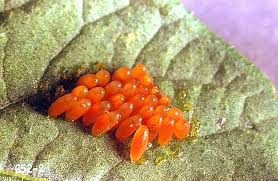
These beetles overwinter in the soil as adults.  They emerge in early spring and lay about 450 eggs in batches of about 12 on the underside of leaves.  The larvae feed under the leaves.  They are reddish, but are identifiable as black blobs, because they cover themselves in their own frass (excrement) which makes them unattractive to predators.  Mature larvae drop to the ground, burrow into the ground, and make a cocoon.  One generation per year is produced.

Host plants:  mostly lilies.  asiatics are most susceptible.  They also feed on fritillaria, lily of the valley (convularia), flowering tobacco (nicotiana), hollyhock, hosta, potato, and solomon’s seal (polygonatum).

To manage these pests:
·         hand pick adults and crush or drop them into a container of soapy water.  The soap will prevent them from breathing.
·         spray with diluted neem oil.  Neem degrades quickly in warm weather, and must be reapplied at least every 5 to 7 days.
·         young larvae are more susceptible to insecticides than adults.  Spray the underside of leaves where larvae feed. 
·         floating row cover may be effective.
A parasitic wasp, Tetrastichus setifer, lays its eggs in beetle larvae.  When the eggs hatch, the wasp larvae eat the beetle larvae from the inside.  PEI has a low number of species of naturally-occurring parasitic wasps (4) vs Ontario (12).

According to http://lilybeetletracker.weebly.com/ this wasp was introduced in Ottawa in 2012 and a researcher at Carleton Univerisity wants to introduce the wasp to other areas across Canada.  According to her studies, the wasp attacks only lily leaf beetles, and it survives the winter.  Gardeners are welcome to sign up to introduce pupae and eggs to their gardens.
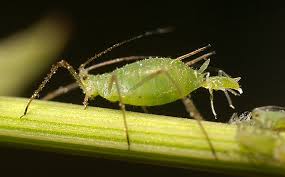
Image result for aphids on plants
Aphids are soft-bodied, tiny, pear-shaped insects that can be brown, black, green, white, or grey.  They can be identified by short tubes protruding from the base of the body, and a waxy or woolly coating. 

Females produce live babies.  They are like Russian dolls - one inside the other.  Babies are born already pregnant, and the babies inside the babies are also already pregnant!  For that reason, aphids reproduce very quickly.  The babies produced are wingless, but if populations become too large and food becomes scarce, babies are born with wings so that they can fly to a new food source.  During the summer, all babies born are female.  In fall, both males and females are born with wings.  They mate and lay eggs, which overwinter. 

Aphids have mouthparts that pierce the stems of plants to suck out plant juices.  Because they attack multiple plants, they can spread disease.  This is a problem for commercial growers.

Aphids feed in large groups on the undersides of leaves.  Predators include lady beetle larvae and adults and predatory wasps, which lay eggs inside the larvae. Spraying with insecticidal soap is effective, but you can also just spray with plain water to knock them off the plants.

Greenhouse growers use Aphidius colmani - one package per square metre.  A BC company called Bug Factory sells these.  This is not as effective in open areas.
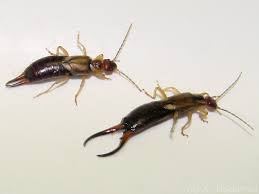
Image result for earwig larvae
Earwigs – males have curved pincers, females have straight pincers.  The females are very good mothers.  They lay eggs in a nest in the ground and feed and protect their young for several weeks until they are ready to leave the nest in early July.  Babies hatch looking like smaller adults – no larvae stage.   

Earwigs are most active at night.  In the late fall, their blood is replaced with a substance that acts as antifreeze, and they are able to withstand the winter.  Adults emerge in spring, lay eggs, tend their young, and then die.

Management: 
·         break up soil and expose eggs on surface for predators. 
·         rolled up newspapers or pieces of garden hose will attract them during the day.  Shake the paper and hose into a bucket of soapy water.

Image result for mites on plants
Mites feed on the undersides of leaves.  Females lay about 300 eggs on the branches or stems of their host plan and overwinter there.  They hatch in early spring and begin feeding.  They grow from egg to adult in just 5 days when it is warm, longer when is cool.  Several generations are produced in one year. 

Management:
·         bring in lady beetles, lacewings, or predatory wasps.  This works best in confined space like a greenhouse
·         spray with insecticidal soap, neem, or a registered insecticide.  To be effective, there must be direct contact with the insect.
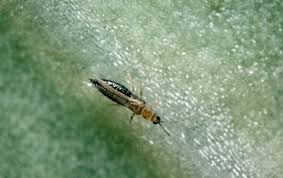
Image result for thrips
Thrips have lacy wings that look like feathers.  There are 6 stages to the life cycle:  egg, 2 larval stages, prepupal, pupal, adult.  One generation takes one month to complete.  They are poor fliers, and are carried by the wind.  Thrip damage makes leaves appear brownor mottled silver, and dry rather than wilted.  They feed on the underside of leaves. 

Management:  Biological controls are not successful.  Because they feed on weeds, keep weeds controlled.  They also will attack stressed plants, so keep your plants well watered and healthy. 
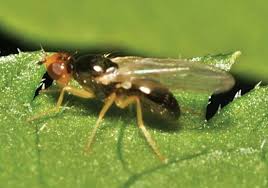
Image result for carrot rust fly
damage from carrot rust fly larvae
Carrot rust fly larvae feed on the tissue of carrots.  It is very small, with red eyes, orange head, a shiny back, and clear wings.  They lay eggs in the soil at the base of carrots.  Eggs hatch in 6-10 days.  Larva feed on carrots, celery, parsley, parsnip, dill, caraway, and fennel.
Management:
·         They are poor flyers, so putting up a low barrier can deter them
·         cover with floating row cover
·         avoid bruising carrot leaves – they are attracted to the scent
·         seed carrots later in the season to avoid the larvae’s life cycle
·         harvest carrots before the second week in September to avoid major damage
·         Resistafly is a variety of carrot seed available at Vesseys.com.  It’s leaves have no scent, and does not attract carrot rust fly.
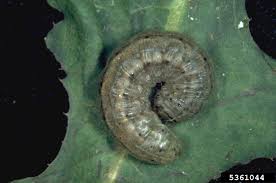
Image result for cutworm
Cutworms overwinter as eggs, larvae, pupae and as adults.  They feed by cutting young seedlings at their base.  They are attracted to weedy areas. 
Management: 
·         cultivate soil to expose cutworms to predators
·         planting late starves them
·         they are nocturnal – hand pick at night
·         put a collar of cardboard or foil around each plant
·         they overwinter in debris – clear away their habitat
·         ground beetles and birds are great predators
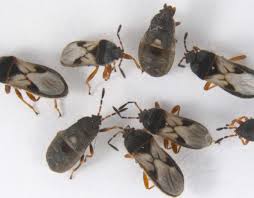
Image result for chinch bugs images
Chinch bugs have sucking mouthparts that feed on grass blades and roots.  Adults are black with white spots and white wings.  The nymph is bright red with white bands across the back.They are attracted to poorly tended lawns and compacted soils with lots of thatch buildup and lack of moisture.
Management:
·         aerate and remove thatch from lawns
·         use slow-release fertilizer and lime
·         keep lawn moist
·         do not cut lawn too short, which stresses the plants
from left:  larva of Japanese beetle, European chafer, and June beetle
June beetles have a 3-year life cycle.  Grubs eat grass roots.  In June, adults lay their eggs in the soil.  They hatch in 2 weeks.
Management:

  • a healthy lawn is the best protection against grubs
  • skunks and crows are dig up the lawn to feed on grubs
  • parasitic nematodes will control them – need the right kind, and the soil must be moist to be effective
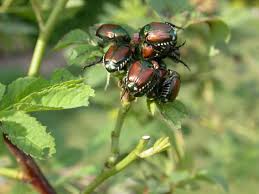
Image result for japanese beetle
Japanese beetles have invaded PEI in the last 4 years.  There is a huge population in the Charlottetown, Cornwall, Canoe Cove area. They attack trees such as crab apple, elm, maples, but mostly concentrate on roses.  The beetles are very beautiful, with iridescent bodies, but very destructive.  The larvae are in the ground where they attack roots.  The adults can skeletonize leaves very quickly.  They overwinter as grubs that are smaller than June beetles.
Management: 
·         hand pick and knock into jar of soapy water
·         insecticidal soap must make direct contact with beetle
·         pheramone use:  be cautious, because this attracts more to your area
·         check soil in late summer:  more than 12 grubs per square feet means you need to treat the lawn
Image result for colorado potato beetle
Colorado Potato Beetle attacks potatoes, tomatoes.  The yellow eggs are laid on the underside of leaves.  The young and the adults feed on leaves.  The young shed their skin 4 times as they grow (instars) and overwinter in the ground. 
Management:
·         hand pick and knock into jar of soapy water
·         kill eggs by crushing
·         Bacillus thurengis may work on larvae
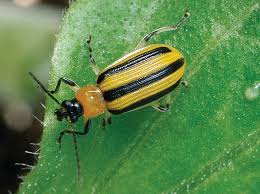
Image result for striped cucumber beetle bacterial wilt

Striped Cucumber Beetle overwinters as an adult.  It lays eggs in the soil.  Adults eat leaves, pollen, and flowers of cucumber plants.  The larvae eat the roots and stems.  It can spread bacterial disease, which appears as bacterial wilt.  Infected plants cannot be saved.
Management: use floating row cover to keep them away from plants.
Image result for colorado potato beetleImage result for colorado potato beetle
Image result for sawfly
Sawflies – Rose Slug look like tiny caterpillars.  When you disturb the larvae, they raise their back end, which caterpillars do not do.  Adults lay eggs on leaves, and the larvae eat all spring and summer, skeletonizing the leaves.  Host plants include roses, raspberries, ash, elm, dogwood, willow.  They are hard to remove from the plant because they are on the undersides of leaves.
damage from viburnum leaf beetle


Image result for viburnum leaf beetle

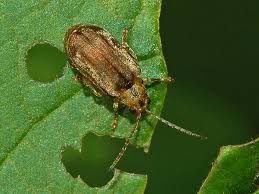
Viburnum leaf beetle is greyish-brown. The yellow and black larvae eat holes in viburnum leaves, leaving only the large veins behind.  To check for an infestation, check stems of plants.  Rows of bumps mean there are eggs buried in the stem.
Management:
·         They are too numerous to hand pick.
·         In fall when leaves have fallen, cut off infected stems
·         Spray insecticide when larvae are young
Image result for colorado potato beetle·         They crawl down the stem to the ground to pupate.  Covering stems with tanglefoot can trap them.

Image result for brown marmorated stink bug
Brown marmorated stink bug, an insect not previously seen on our continent, was accidentally introduced into Pennsylvania. It was first collected in 1998. 

Adults are approximately 17 mm long and are shades of brown on both the upper and lower body surfaces.  They have the typical “shield” shape of other stink bugs, almost as wide as they are long. To distinguish them from other stink bugs, look for lighter bands on the antennae and darker bands on the membranous, overlapping part at the rear of the front pair of wings. They have patches of coppery or bluish-metallic rounded depressions on the head.

The name “stink bug” refers to the scent glands located on the dorsal surface of the abdomen and the underside of the thorax. It releases a bad odour if crushed.

In its native range, it feeds on a wide variety of plants, including apples, peaches, figs, mulberries, citrus fruits and persimmons. This true bug has also been reported on many ornamental plants, weeds, soybeans and beans for human consumption. Feeding on fruits such as apple results in a characteristic distortion referred to as “cat facing,” that causes the fruit to be   unmarketable.

These bugs are a big problem in the US and have been found in the Niagara region of Ontario, where they are a major threat to fruit production.  They were spread by hitching rides on Home Depot trucks moving goods from the US to Ontario, and have been found on trucks on PEI as well.  These bugs even survive going through the washing machine.

If you find this bug on PEI, please catch it in an escape-resistant container and bring it to Christine Noronha at the Agriculture and Agri-Food Canada building on University Avenue in Charlottetown, or call her at 902-394-1350.